

Guilin · Place guide
Longji Rice Terraces
A 2,300-year-old cascade of rice terraces carved into Longji mountain, home to Zhuang and Yao villages.
Read the guide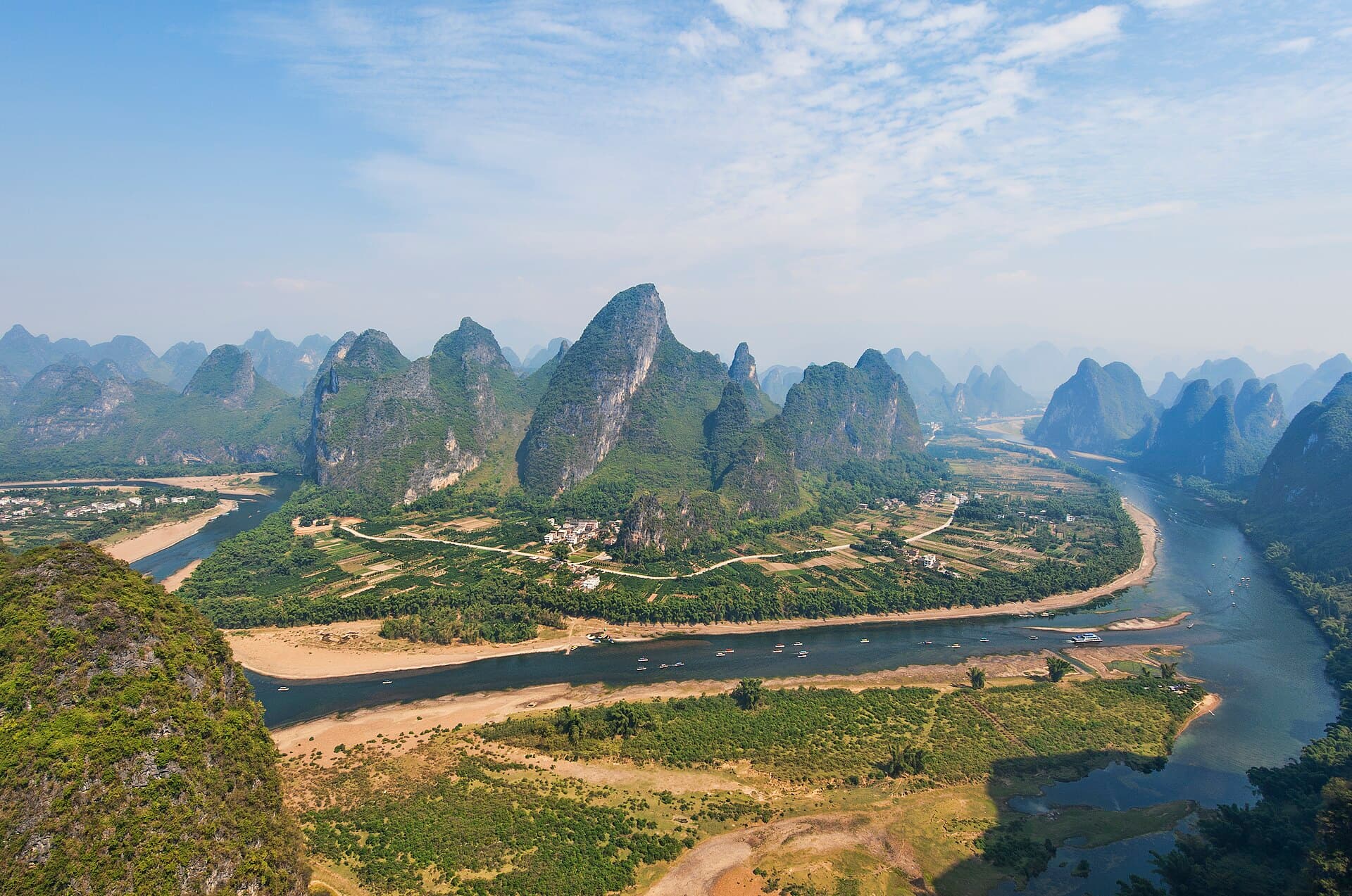
Karst (limestone landscape eroded by water) peaks, mirror-still Li River, and rice-terraced villages define this southern China icon.
 亲手写并签名 Ivy Chen
Guilin, a 2,133-year-old river city in northeast Guangxi, is famed for its karst (limestone landscape eroded by water) peaks and the slow Li River. The 27,800 sq km city feels like a living painting: bamboo rafts between conical mountains, mirror water at dawn, and rice terraces spilling down forested hills. Visitors pair the city with Yangshuo or Longji.
Give it two to three days and watch the forecast — brilliant in clear weather, flat and even risky in a downpour, and not the place for a rushed one-day stop.
The Li River corridor between Guilin and Yangshuo is one of the most photographed river landscapes in the world: a 65-km sweep of conical karst (limestone landscape eroded by water) peaks rising from a flat mirror-bend water surface. Best viewed at dawn from a slow bamboo raft or from Xianggong Mountain overlook, when low mist pools in the bends and the limestone glows pink. The scene is so iconic it appears on the back of the CNY 20 banknote.
About 100 km north of Guilin, the Longji (Dragon's Backbone) terraces are hand-built rice paddies climbing from 300 m to 1,100 m elevation, cut into the hillside by Yao and Zhuang minority communities over 700 years. The water-filled paddies in late May act as mirrors; in late September they turn gold at harvest. The Seven Stars with Moon viewpoint is the most-photographed angle, best at 6-8 AM after a rainy night when the contours reflect in still water.
The Lingqu Canal, built in 214 BC under the Qin Dynasty (221-206 BC, China's first unified empire), is one of the oldest navigable canals still in use. It connects the Yangtze (China's longest river, roughly 6300 km) and Pearl River systems (the two longest river basins in southern China) and is a UNESCO-recognized feat of ancient engineering. Visitors can walk a section near Xing'an and see the original stone dam, the lock gates, and the slow barges that still use the route.
Guilin · Place guide
A 2,300-year-old cascade of rice terraces carved into Longji mountain, home to Zhuang and Yao villages.
Read the guide
Guilin · Place guide
A 164-kilometre karst river in Guangxi, famed for bamboo-raft cruises between Mopanshan pier and Yangshuo.
Read the guide