

Lijiang · Place guide
Jade Dragon Snow Mountain
A high-altitude mountain day in Yunnan, pairing glacier views, cable cars, and changing cloud light.
Read the guide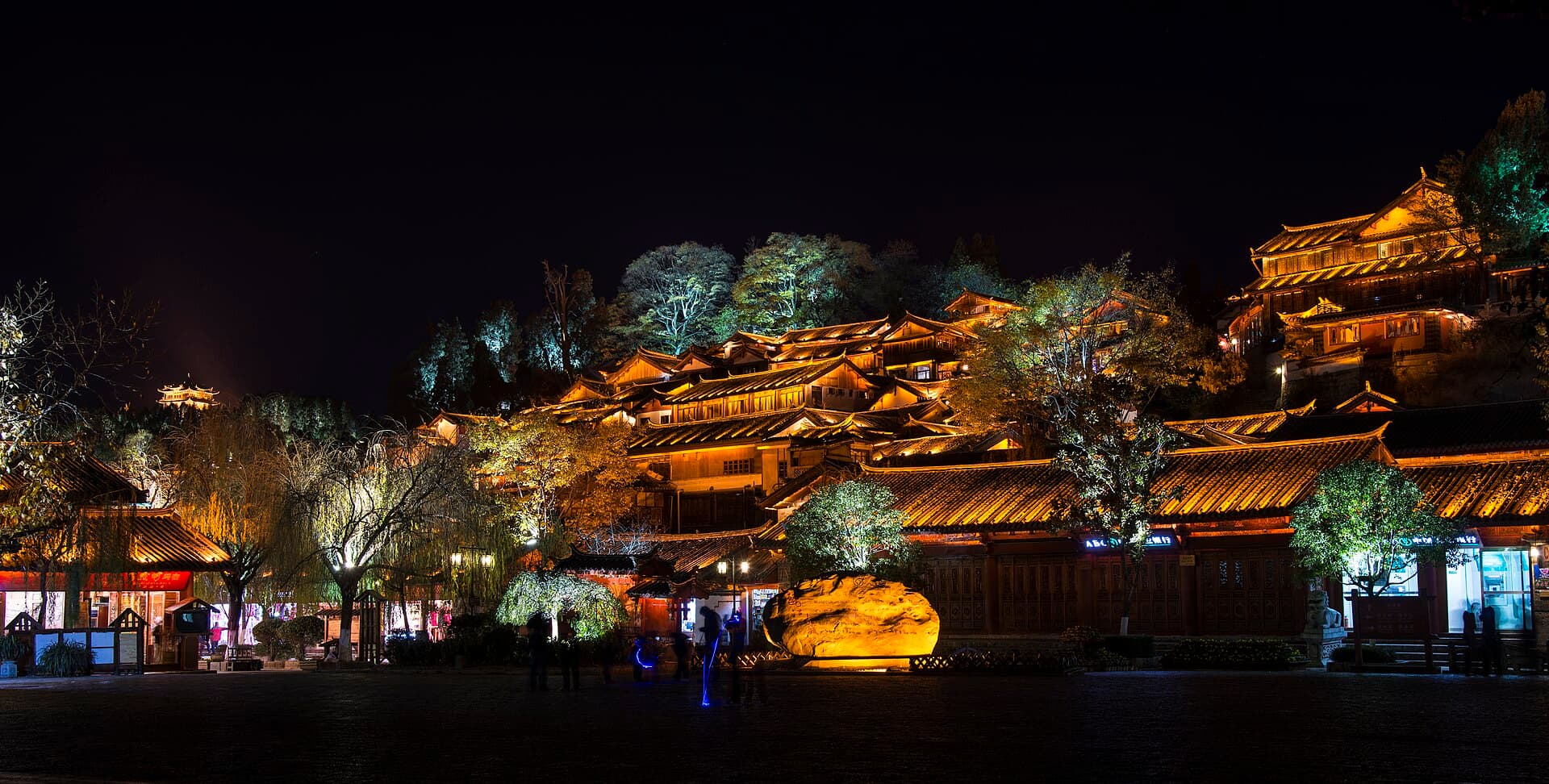
A car-free Naxi market town of grey-tile rooftops, red cobble lanes, canal-side courtyards, and Yulong Snow Mountain views.
 亲手写并签名 Ivy Chen
Dayan is the walled heart of Lijiang Old Town (UNESCO-listed Naxi water town in Yunnan), a UNESCO World Heritage site since 1997. Across 7.27 sq km of red cobble lanes, the town stitches Mu Palace, Sifangjie Square, the Wangu Tower outlook, and China's closest snow-mountain framing. A working market town, with Naxi guqin and Dongjing music in the square.
Worth it if you go in knowing it's a busy, commercial tourist town and you time it right, get there early morning or late evening to beat the crowds and enjoy the lanes; skip it if you want an authentic untouched village or quiet nights, or if hauling luggage over cobblestones and dealing with bad traffic will ruin your mood.
Wander Dayan (literally 'great ink slab,' the walled Naxi market town at the heart of Lijiang Old Town (UNESCO-listed Naxi water town in Yunnan)) where 5-m-wide lanes of red breccia flagstone (coarse red-and-grey river rock) cross at will; no motor vehicles, no walls, no compass grid. The cobbled alleys descend with the canal, then split around tiny stone bridges, so the route always reveals a new roofline of grey tile or a canal-side washing-stone the moment you turn.
Sifangjie Square (Sifangjie, the 'four-direction' marketplace at the old town's heart) still hosts unscripted Naxi guqin (guqin, a seven-stringed zither central to literati culture) and Dongjing music (Dongjing, a Naxi fusion of Confucian temple orchestra and folk tunes recognized by UNESCO in 2003) sessions in the open square. Drop in after 8 PM when most tourist crowds thin and locals tune up around the old well; the sound carries down the canals for two or three blocks.
Mufu Palace (the Mu family mansion, residence of the Ming-dynasty (1368-1644 AD, Chinese imperial dynasty) hereditary tusi (tusi, a Chinese term for a hereditary tribal chieftain appointed by the central government) chieftain, rebuilt 1999) rises against Lion Hill with carved dragon-and-phoenix gates and a Tianjidiansheng tablet (a calligraphic plaque gifted by the Wanli Emperor (r. 1572-1620) of Ming China, hung in the main hall). Climb the Yutade Platform at the rear for a single-frame view of grey-tile rooftops and Yulong Snow Mountain in one composition.
Black Dragon Pool (Heilongtan, a spring-fed pool just north of Dayan, popular with local retirees) frames Yulong Snow Mountain (Yulong Xueshan, 5,596 m, the closest snow peak to a Chinese city center) perfectly at sunrise. A weathered marble arch (built 1737, Qing Dynasty (1644-1912)) and the Deyue Pavilion (Moon-Worshipping Pavilion) sit on the far bank, mirrored in the still water. Arrive by 7:30 AM in autumn for a clean reflection and a line of elderly residents practicing tai chi against the snow line.
One Lijiang-internet-icon spot lives on a small canal arch near Xianwen Bridge: stand on the bridge side, the cobble lane, the canal, the low grey-tile houses, and the distant Yulong range line up in a single vertical. Photographers line up from 7 AM in clear weather; weekday off-season visits get the composition clean. Sunrise gives a warm edge on the tiles, late afternoon softens the snow.
Wild mushroom (jianjun, 'mountain mushrooms' picked July-September from Yulong's pine forests) hot pot is the one dish to try in Lijiang, cooked at the table in a clay pot of chicken or cured-ham broth. The broth waits for every mushroom to finish cooking (never lift the lid early); a chalk-countdown clock on the table tracks the 15-minute mark, then you eat. Skip tourist-trap Sifangjie frontage and look two streets back where the same dish costs half.
Around the old town you can rent traditional Naxi dress (cape-style 'xuelian' shoulder-piece over a belted jacket) and walk the lanes and canals in a one-hour photo session; several studios cluster near Mu's main gate. The costume is layered so it photographs in any weather, and the cobble lanes give a long clean backdrop. Best light sits 90 minutes before sunset; book through your guesthouse the day before.
The single most-photographed Lijiang shot is an aerial of Dayan Old Town from a low-flying drone at blue hour (5-10 minutes after sunset, when the sky holds deep blue and the warm lanterns below are fully on). The grey-tile roof grid is so dense and uniform that the frame reads like circuit board under string-light veins. Confirm no-fly rules with the guesthouse and avoid launching over Mufu Palace or the town center for permit reasons.