
Hanshan Temple
A 1,500-year-old canal temple whose midnight bell carries China's most memorised Tang poem.
 亲手写并签名 Lena Zhou
这里到底是什么
Hanshan Temple is a working Buddhist monastery west of old Suzhou, founded in 502 AD and rebuilt many times. Its bell and its stele corridor carry Zhang Ji's Tang Dynasty (618-907 AD) poem about a traveller hearing the temple bell at midnight. Grounds are compact; the free canal walk outside doubles the visit.
编辑点评
Worth it as a cheap, short, literary stop rather than a headline sight. Come at opening, read Zhang Ji's four lines first, give the free canal strip outside equal time, and you get an hour that explains a poem every Chinese schoolchild knows. If you want scale, silence or deep monastic atmosphere, go east to Xiyuan Temple instead, and if your only free slot is a holiday afternoon in August, skip it without regret.
实用信息
须知
正在流行
The stele corridor of one poem
A roofed walkway lined with stone tablets carrying Zhang Ji's Fengqiao Yebo (Night Mooring by Maple Bridge), cut and re-cut by later calligraphers. Visitors describe reading the verse here and only then understanding what the bell and the bridge outside are about. One tablet version of the poem was famous enough in Japan to be coveted during the wartime occupation.
Bell tower and the midnight strike
The bell is the reason the temple is quoted rather than merely visited. A separate bell court near the pagoda lets visitors hear a strike up close, and the New Year bell ringing is the temple's biggest event of the year. Check on arrival whether striking is running, as the great bell tower has been shut for repairs in some seasons.
Ochre walls, grey tiles, wind chimes
The buildings you walk through are mostly Qing Dynasty (1644-1912) rebuilds in the local canal-country idiom: ochre plaster walls, dark grey tiles, upturned eaves hung with small chimes. Visitors consistently describe the sound of chimes at the eaves layered over a distant bell as the thing that slows them down here.
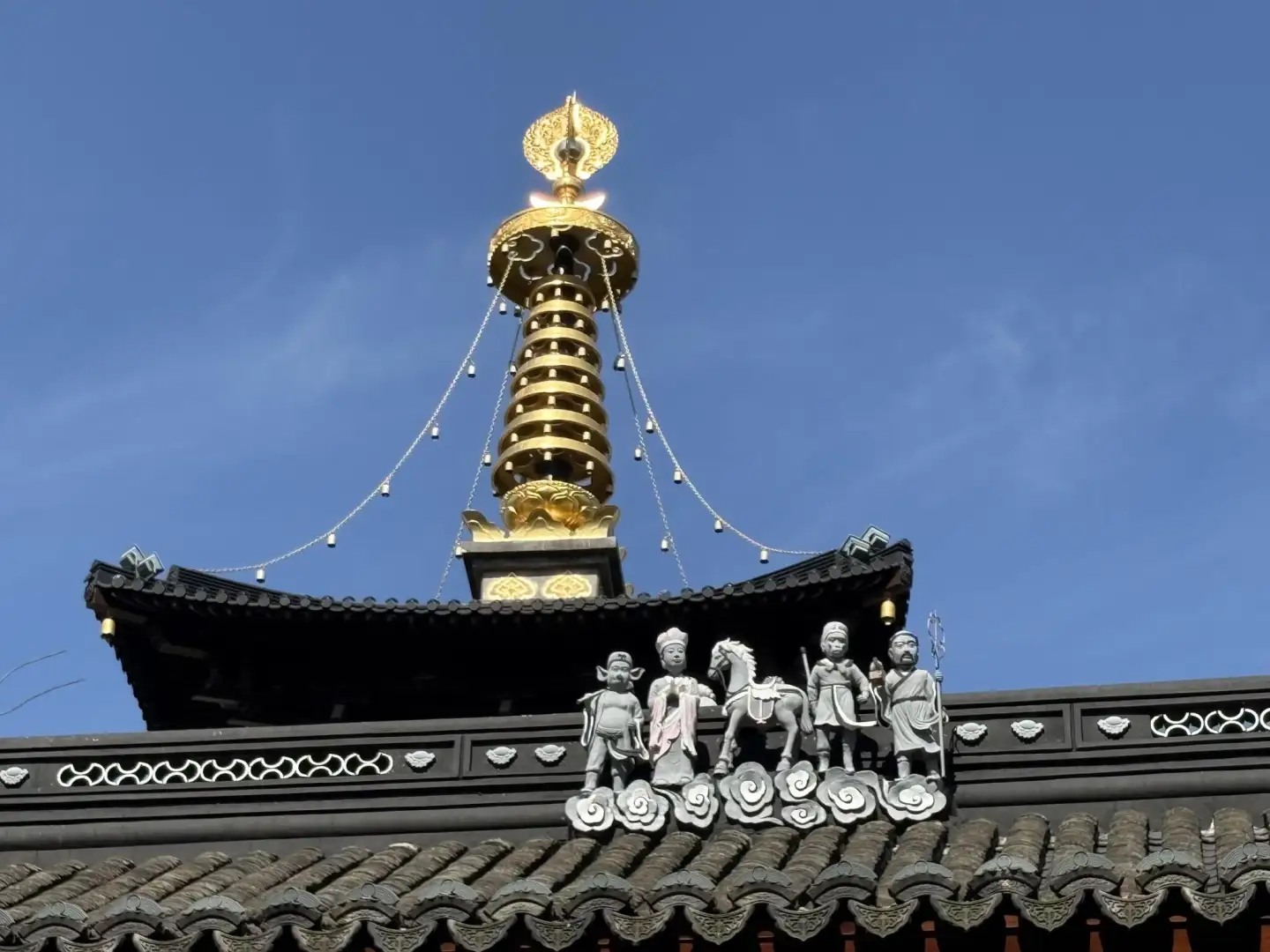
Brick pagoda with carved figures
The tallest structure on site is a multi-tier brick pagoda that anchors every wide shot from the courtyard. Visitors point out carved figures from Xiyou Ji (Journey to the West, the sixteenth-century novel of a monk's pilgrimage to India) on the upper tiers, which makes the climbable-looking tower a favourite with families.
Koi pond in the courtyard
A stone-rimmed pond of unusually large, tame carp that come to the edge for food. It is the one stop where children slow the whole group down, and the fish are a running theme in visitor notes about the temple. The rim stays wet, so footing near the water is poor.
The free half outside the wall
Only the temple interior needs the CNY 20 ticket. The outer wall lane and the Fengqiao canal frontage are free, and one visitor who shot both halves rated the outside scenery just as strong: low bridges, water-side lanes and moored boats in the canal-town style of eastern China.