Skip to content
InChina 已经上架 App Store去下载 →
Suzhou Silk Museum
Suzhou · Jiangsu · Place

Suzhou Silk Museum

China's first silk museum: 7000 years of silk civilization, live Song-Jin brocade looms, free entry near Beisita Pagoda.

Alex Chu亲手写并签名 Alex Chu
4.6/5评分Free admission, no reservation required, security check on entry门票Tue-Sun 9:00-17:00 (last entry 16:00); Future Hall to 20:00开放时间

这里到底是什么

China's first professional silk museum near Beisita Pagoda, set in a 9460 m2 complex of six themed halls. Visitors watch live Song-Jin brocade (a UNESCO-listed brocade technique) weavers operate tall wooden looms, then stroll past Ming-dynasty (1368-1644) imperial robes and silkworm life-cycle displays. Free entry, no reservation, easy metro access from Line 4.

编辑点评

Alex Chu
Alex Chu亲手写并签名
综评

Worth a half-day if you are already in Suzhou for the gardens; skip if you have less than a day in the city or your group has no interest in textile craft. Best on a weekday morning to avoid the loom-hall crowd; arrive before 9:30 if you want a free locker.

亮点
Live Song-Jin brocade loom demonstration is the single most talked-about element in recent visitor notes; even people with no prior interest in textiles stay to watch for 20-30 minutes.
Free entry with no reservation is repeatedly described as a relief compared with Suzhou's other major sights, and shortens the visit to about 90 minutes if you skip the Future Hall.
The Ming-dynasty imperial robe and the silkworm life-cycle room are the two exhibits visitors recommend to friends; both are family-friendly.
要注意
Several recent visitors note the Future Hall feels tired and the VR weaving exhibit often does not work on weekday afternoons.
A number of complaints mention that the Weaving and Dyeing Workshop gets crowded within minutes of each loom demonstration, and the audio guide is in Chinese only.
提炼自 14+ 条旅行者点评。 由我们的编辑从小红书和抖音的旅行者点评里提炼。

实用信息

开放时间Tue-Sun 9:00-17:00 (last entry 16:00); Future Hall to 20:00
门票Free admission, no reservation required, security check on entry
联系+86-512-67539943
评分4.6/5

须知

Free entry, no reservation requiredFree admission, no reservation required, security check on entry
No flash photography in History HallFlash photography prohibited in the History Hall to protect the silk textiles
No food, drink, or smoking in galleriesFood, drink, and smoking prohibited inside the exhibition galleries
Free entry, no reservation requiredFree admission with no booking needed; just pass the security check at the entrance.
Take Metro Line 4 to Beisita Station, Exit 5, and walk 300 m north along Renmin Road.
Wear flat shoes; the History Hall has multiple levels and uneven outdoor paths.
Closed Mondays except public holidays; check the calendar before rearranging.
Free luggage storage near the entrance; security screening happens before the locker zone.

正在流行

Live Song-Jin Brocade Looms

Two teams of weavers in the Weaving and Dyeing Workshop operate an 8-metre-tall Song-Jin pickup loom and a Wucai Zhangduan loom by hand, and you can stand close enough to hear the shuttle. Song-Jin (a UNESCO-listed brocade technique named after the Song and Jin dynasties) is the highest-skill silk-weaving method in China; the museum is one of the few places where it is still demonstrated daily.

Ming-Dynasty Imperial Robe as Treasure

The Ancient Hall holds the museum's signature piece: a Ming-dynasty (1368-1644) Huang Duan Di Shidi Kongque Wen Zhicheng Lanpao, a yellow satin robe woven with persimmon-calyx and peacock motifs that was once a tribute weaver's masterwork. Other standouts include Tang-dynasty (618-907 AD) silk fragments and Republican-era qipao (a tight-fitting cheongsam dress that became the signature women's wear of 1920s-1940s China).

Silkworm Life-Cycle Room

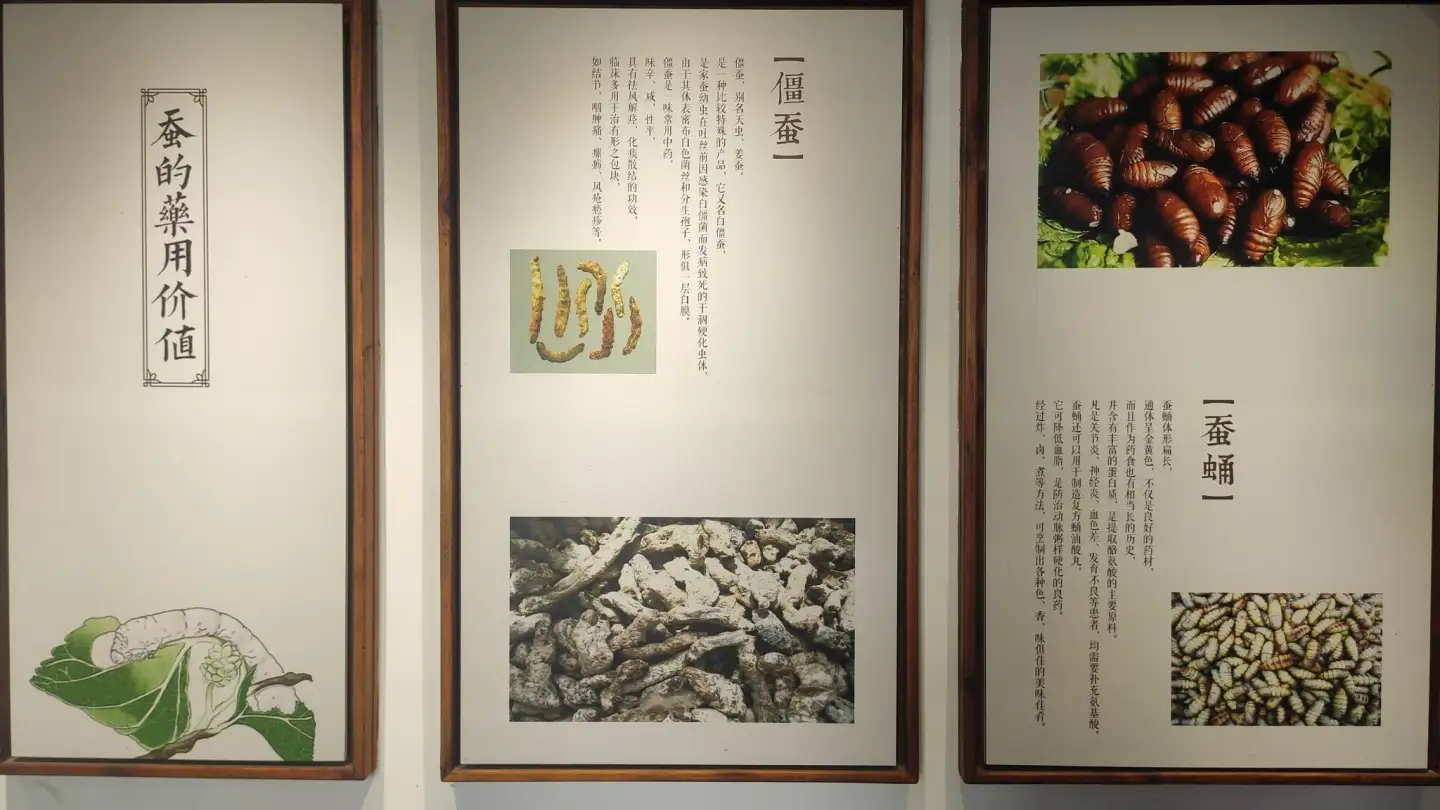
In the Cansang Dwelling you can see every stage of a silkworm's life (egg, larva, pupa, moth) on mulberry leaves under glass, and a small speaker plays the soft rustle of caterpillars feeding. Outside, the Sangzi Garden recreates a small Jiangnan (literally south of the Yangtze (China's longest river, roughly 6300 km), the lower Yangtze cultural region) silkworm-raising household around a real mulberry grove.

怎么到达

metroLine 4 Beisita Station, Exit 5, 300 m north on Renmin Road (~5 min walk).
busRoutes 1, 5, 8, 38, 101, 811, You-4 to Pingmen Stop, 200 m walk east.
carLimited paid parking on Xibei Street; consider DiDi for evening visits.
在 App 里生成 →

Plan around this guide