
Most first trips to China skip Guizhou. That's the reason to go. It's a province of limestone, karst peaks, cave rivers, and some of Asia's biggest waterfalls, stitched together with Miao and Dong villages that still work the land. A week is enough to see six of its best places without feeling rushed, if you plan the order well. Here's a route that does.
Days 1–2: Huangguoshu and the road in
Start big. Huangguoshu is the largest karst waterfall in Asia, a 67-meter drop that spreads 101 meters wide at full flow, documented by the Ming-dynasty traveler Xu Xiake centuries before it had a ticket gate. The best season is June to October, when monsoon rain turns it thunderous; July and August are the most spectacular and the most crowded.
The detail people remember is Water Curtain Cave, a passage that runs behind the full width of the falls. Rent a raincoat at the gate (around 10 yuan) and walk through curtains of spray with the river pouring over the cliff above you. Arrive before 9 AM in peak season to beat the queues. The full ticket runs about 160 yuan, and the park is roughly 150 km from Anshun, the gateway city.
Day 3: Xiaoqikong's emerald water
Two hours south sits Xiaoqikong, a 46-square-kilometer UNESCO karst landscape near Libo with 92% forest cover. Where Huangguoshu is loud and vertical, this is green and horizontal, a 1.6-km stretch of 68 small waterfalls, jade lakes, and a famous 19th-century arch bridge that gives the area its name.
The signature stop is Wolong Tan, a glass-green pool where you can row a transparent boat across water clear enough to see the bottom. Best March to October; skip it right after heavy rain, when the falls turn muddy. The ticket is 120 CNY, and you can reach Libo by high-speed rail from Guiyang in about 90 minutes (around 91 CNY), then a short bus to the gate.
Day 4: Wanfenglin's forest of peaks
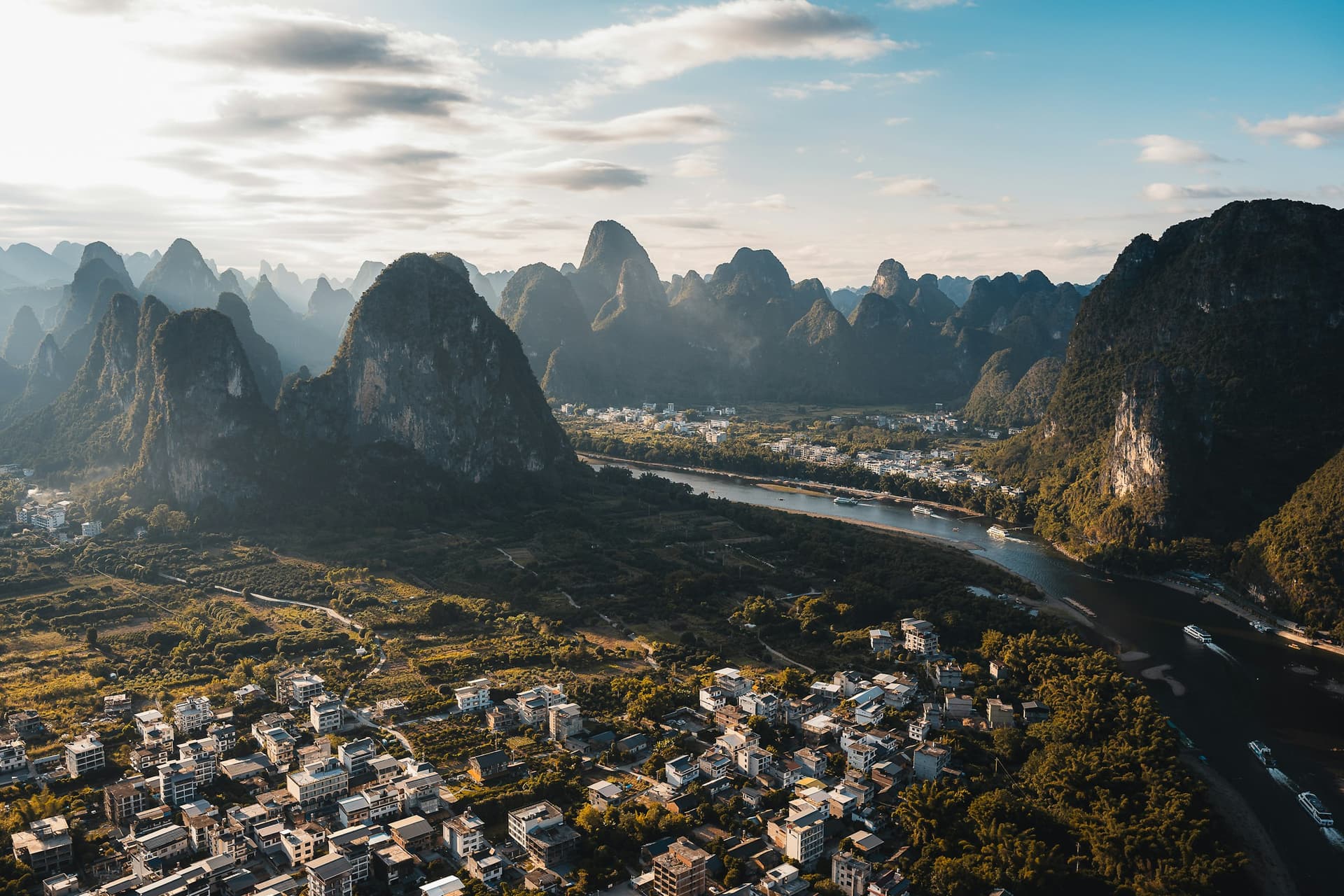
Cross to the southwest for Wanfenglin near Xingyi, over 20,000 cone-shaped karst peaks rising straight out of the rice paddies. Xu Xiake wrote that nowhere else do peaks form forests like they do here; UNESCO made it a Global Geopark in 2024.
Don't over-plan this one. Pick up an electric bike at the village entrance and ride the paddy trails with no schedule, past fish ponds, vegetable plots, and countryside cafés. The one thing to actually seek out is the egg fried rice on Yicui Street, around 10 yuan a bowl and genuinely famous. The full ticket is 70 yuan plus a 50-yuan shuttle. March is the showstopper, when rapeseed blooms turn the whole valley yellow.
Days 5–6: Xijiang and a hillside of lamps
Swing east to Xijiang Qianhu Miao Village, the world's largest Miao settlement, 1,468 stilted wooden homes cascading down a forested mountainside, lived in for over 1,700 years. The thing to plan your day around is the Ten Thousand Lights night view: as dusk falls, the windows illuminate the hillside in sequence and the whole village mirrors itself in the Baishui River below. Watch it from the Viewing Platform between 20:00 and 21:30.
The ticket is 90 yuan and valid for two days, so stay overnight in a hillside inn, book early in peak season. Best months are October to March for clear evenings. Spend daylight in Gayika Ancient Alley, where silver-smithing and indigo batik are still done by hand. If you want something quieter and more lived-in, the Dong village of Zhaoxing is two hours away, with five drum towers and UNESCO-listed polyphonic singing, on an 80-yuan ticket.
Day 7: Chishui's red rock
End in the north at Chishui Danxia, a 36.3-square-kilometer UNESCO World Heritage site since 2010. This is a different palette entirely, red Danxia cliffs plunging into a 100-meter waterfall, framed by emerald bamboo seas and ancient cycad groves. Best May to October; wear anti-slip shoes, because wet Danxia rock is genuinely treacherous, and bring a rain jacket for the spray near the falls. The combined ticket is around 180 RMB.
Making the week your own
This is one order that works, but it isn't the only one. Guizhou rewards a flexible plan more than a fixed one, weather moves the waterfalls, and the best month for each place is different. If you'd rather not sequence it by hand, drop these stops into InChina and the AI will draft a day-by-day version drawn from real local guides, then let you drag, swap, and save it offline before you fly.
Plan this week in the app.