
The most common mistake on a first China trip is trying to see "China." The country is closer to a dozen countries stacked inside one border, different landscapes, foods, climates, and rhythms, often a long flight apart. Yunnan tea villages have nothing in common with Gansu's dunes, and neither resembles a Tibetan plateau pass or a 600-year-old Beijing courtyard.
So the real first decision isn't what to see. It's which one region gets your week. Here's how to choose.
If you want the sky to feel enormous: the Tibetan plateau
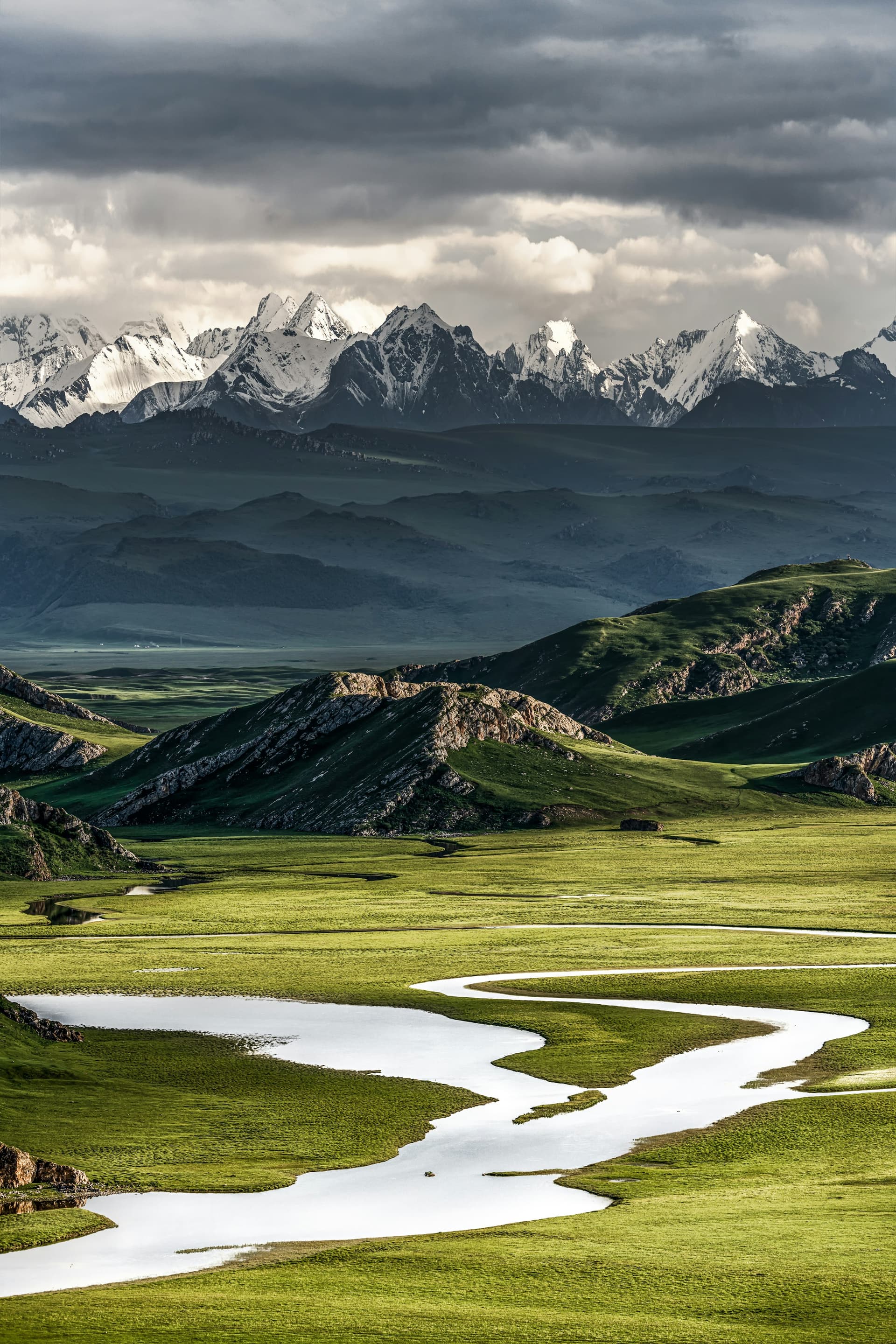
This is where the sky begins, high, thin air and horizons that go on past where weather forms. The plateau is the choice when you want scale over checklist: long drives between sights, altitude that slows you down on purpose, and a quiet that's hard to find anywhere else.
Pick this region if your idea of a great trip is wide-open landscape and you're comfortable taking the first days slow to acclimatize. It's not the week for someone who wants a new museum every afternoon.
If you want desert and the Silk Road: Gansu, Dunhuang
Endless dunes, and under them one of the great stories of human travel. Dunhuang in Gansu is a Silk Road oasis town built around the Mogao Caves, 735 grottoes of Buddhist murals carved between the 4th and 14th centuries, where a guide unlocks the chapels with a physical key and you stand a meter from 1,500-year-old paintings.
The other half is the desert itself: the singing sand dunes of Mingsha Shan and the crescent Yueya Spring, an oasis that hasn't dried in 2,000 years. Best May–June and September–October for mild temperatures; the daily swing from scorching noon to cold night is real, so pack layers. Choose Gansu if history and desert landscape excite you in equal measure.
If you want green and gentle: Guangxi, Longsheng
Living rice terraces, hillsides carved into curving steps that fill with water and mirror the sky in planting season, then turn gold at harvest. Guangxi's Longsheng region is the soft, green, photographic counterpoint to the plateau and the desert: warm, walkable, built around villages rather than monuments.
This is the easy-paced region, minority villages, terrace viewpoints, slow days. Good for a first China trip where you want beauty without altitude or extreme heat.
If you want history in a working city: Beijing, the old city
Six hundred years of courtyards, walked daily, not roped off. Beijing's old city is the region for travelers who want depth and convenience in the same place, imperial scale and hutong life within one metro map, with the food, transit, and English signage of a major capital.
Pick Beijing if it's your first time in China and you want the famous things done well, with the least logistical friction. It's the most forgiving region to start with.
If you want mountains in the clouds: Anhui, Huangshan
Cloud-walking. Huangshan, the Yellow Mountains, is granite peaks, twisted pines, and a sea of cloud that pools below the summit at dawn. It's a focused, vertical region: you come for the mountain and the villages at its feet, and you give it a few concentrated days rather than spreading thin.
Choose Anhui if a single iconic landscape, hiked properly, beats a sampler of many. Pack for cold at the summit even in warm months.
If you want slow mornings and tea: Yunnan, Pu'er
Tea villages at dawn, misty hills, old tea trees, and a pace that rewards staying put. Yunnan is the deep, slow region: it's also home to Dali, a walled 1,000-year-old Bai-minority town between Cangshan mountain and the 250-km² Erhai lake, where travelers settle in for days and circle the lake by rented scooter.
Yunnan suits the traveler who'd rather know one valley well than rush five. It's the strongest pick for a slow-travel week.
Narrowing it down
A simple filter: the plateau and Gansu reward people chasing scale and story; Guangxi and Yunnan reward those who want green, gentle, and slow; Beijing rewards first-timers who want famous things with easy logistics; Anhui rewards anyone willing to give one great mountain its due.
You don't have to lock it perfectly. Open any of these regions in InChina, tell it your days and what you care about, food, history, nature, photography, and the AI drafts a day-by-day plan from real local guides. Pick the country-within-China first; let the app sort the week.
Pick your region in the app.