
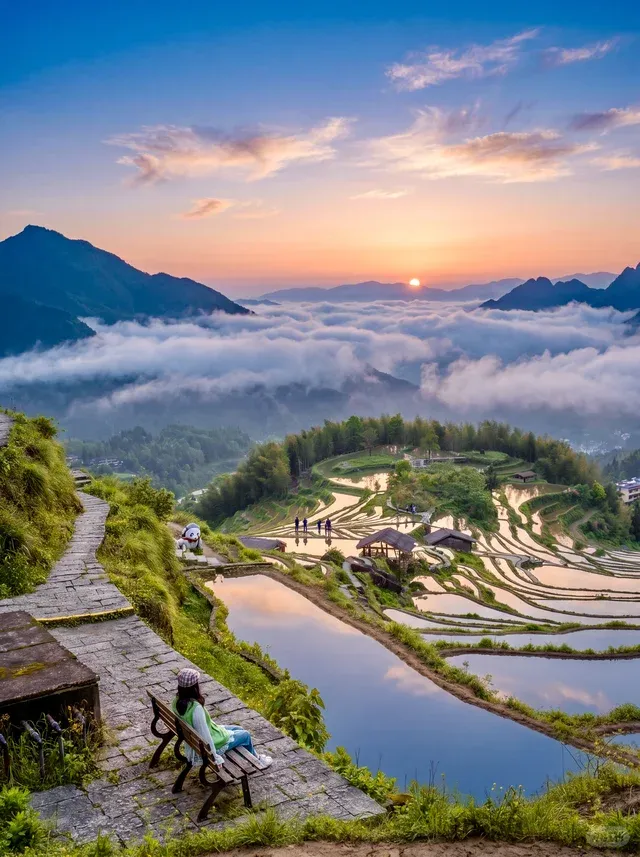
Yunhe Rice Terraces
Cascading rice terraces carved into 1000m mountains, famous for sea-of-clouds sunrises and ancient She-ethnic villages.
 Written and signed by Alex Chu
What it actually is
Sculpted over a millennium by She-ethnic (Shē, a Chinese minority native to Zhejiang and Fujian) farmers, the Yunhe Rice Terraces climb 1000 vertical meters on Daiyun Mountain's eastern flank. Three sub-zones — Jiuqu Yunhuan for cloud-sea sunrises, Qixingdun for high-altitude viewing, and Baiyin Valley for waterfalls and stone villages — make it one of eastern China's most layered cultural landscapes.
Editor's take
Worth it if you time it for golden-autumn or flooded-spring, buffer extra mornings for the cloud-sea, and don't mind that reality is calmer than the photos — great for patient landscape shooters and slow travelers. I'd skip it if you're chasing one guaranteed sunrise on a fixed date or expect the dramatic staged shots to just happen; go early, go in the right season, or don't bother.
Essentials
Good to know
Trending now
Sea-of-Clouds Sunrise from Jiuqu Yunhuan
Jiǔqū Yúnhuán (Nine-Bend Cloud Ring) is the most photographed viewpoint — terraced fields stack below you and clouds pour through the valleys (best at 5:30-7:00 AM in Apr-Oct when mist lifts). The glass sky-walk juts over the edge for vertigo-laced shots over 700 layers of flooded paddies.
Seven-Star Mound Cloud Cafe
Qīxīng Dūn (Seven-Star Mound) sits at 1058 m — the highest point reached by cable car. A tiny glass-walled cafe serves locally-grown yún hé (Yunhe) tea while you sit above the cloud layer. The cliffside swing here is the most Instagrammed prop on the mountain.
Wujian Waterfall and Kenggen Stone Village
Wū Jiàn Fēi Pù (Black Stream Flying Waterfall) is a 30 m cascade hidden inside Báiyín Gǔ (Silver Valley) — quiet even on national holidays. The trail continues to Kēnggēn Shí Zhài, a stone-walled She-minority hamlet (Shē is a Chinese ethnic group native to Zhejiang and Fujian) where 80-year-old residents still farm rice by hand.