
Longmen Grottoes
A UNESCO World Heritage treasure: over 1,500 years of Buddhist cave art carved into cliffs along the Yi River near Luoyang, from the Northern Wei to the Tang dynasty.
What it actually is
A UNESCO World Heritage Site carved into the limestone cliffs along the Yi River near Luoyang, with 2,345 caves and 100,000 Buddhist statues carved between the Northern Wei Dynasty (493 AD) and the Tang Dynasty (618-907 AD). The 17-meter Lushena Buddha of Fengxian Temple is the soul of the site.
Essentials
Good to know
Trending now
Fengxian Temple and the Lushena Buddha
The 17.14-meter Vairocana Buddha of Fengxian Temple is the soul of Longmen - carved between 672 and 675 AD under Tang Emperor Gaozong and Empress Wu Zetian. The serene half-smile is widely believed to be modeled on Wu herself, a face that has watched the Yi River for more than 1,300 years.
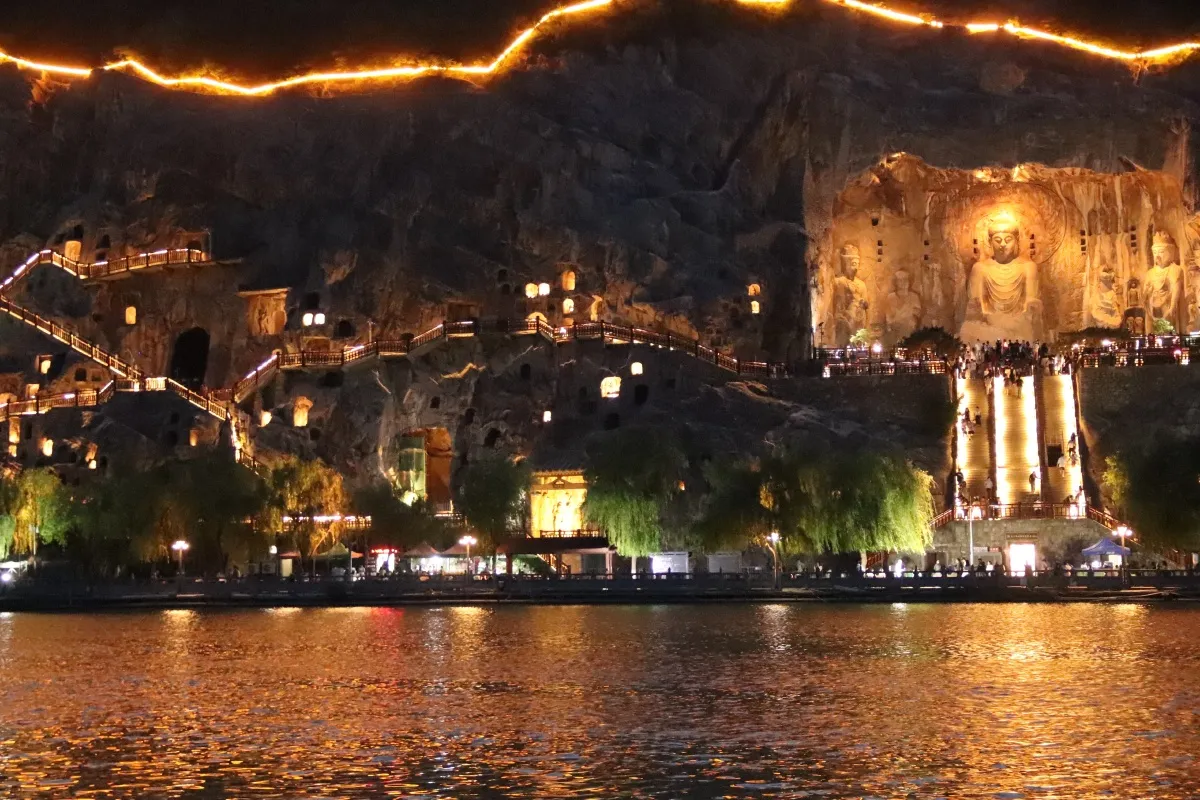
Night tours on the lit Yi River cliffs
From late March the West Mountain caves stay open after dark. Lanterns fill every cave mouth, the river mirrors the lit cliff face, and visitors walk the submerged bridge to Lifo Terrace for the wide illuminated panorama of the Vairocana and his attendants.
Four dynasties, one kilometer of carved cliff
Carving began in 493 AD when the Northern Wei Dynasty moved its capital to Luoyang and continued through Western Wei, Northern Zhou, Sui, Tang, Song, Ming, and Qing - more than 400 years. The cliff preserves 2,345 caves and over 100,000 statues that read like a working timeline of Chinese Buddhist art.
Surviving Tang-era donor inscriptions
Around 2,800 stone inscriptions document the patrons who funded carvings - Tang nobles, monks, and merchants from across Asia including Sogdian, Khotanese, Tokharian, and Korean communities. The smaller caves at Qianxi Temple and Guyang Cave hold the most concentrated donor text.
East Mountain Grottoes across the bridge
Most visitors stay on the West Mountain cliff. Cross the bridge and the East Mountain Grottoes are quieter, holding later Tang Dynasty (618-907 AD) carvings and the Laolong (Old Dragon) Cave spring, where water flows from a carved dragon's mouth.
Baiyuan, the Tang poet's tomb garden
Walk further along the cliffs to Baiyuan, the garden tomb of Bai Juyi (772-846), Tang Dynasty (618-907 AD) poet and former Prefect of Luoyang. The reconstructed thatched cottage, memorial hall with calligraphy scrolls, and his stone tomb make a calm half-hour coda to the carved cliff.
Over 400 years of carving across multiple dynasties
Carving began in 493 AD when the Northern Wei Dynasty moved its capital to Luoyang and continued through Western Wei, Northern Zhou, Sui, Tang, Song, Ming, and Qing. The cliff preserves 2,345 caves and over 100,000 statues that read like a working timeline of Chinese Buddhist art.