
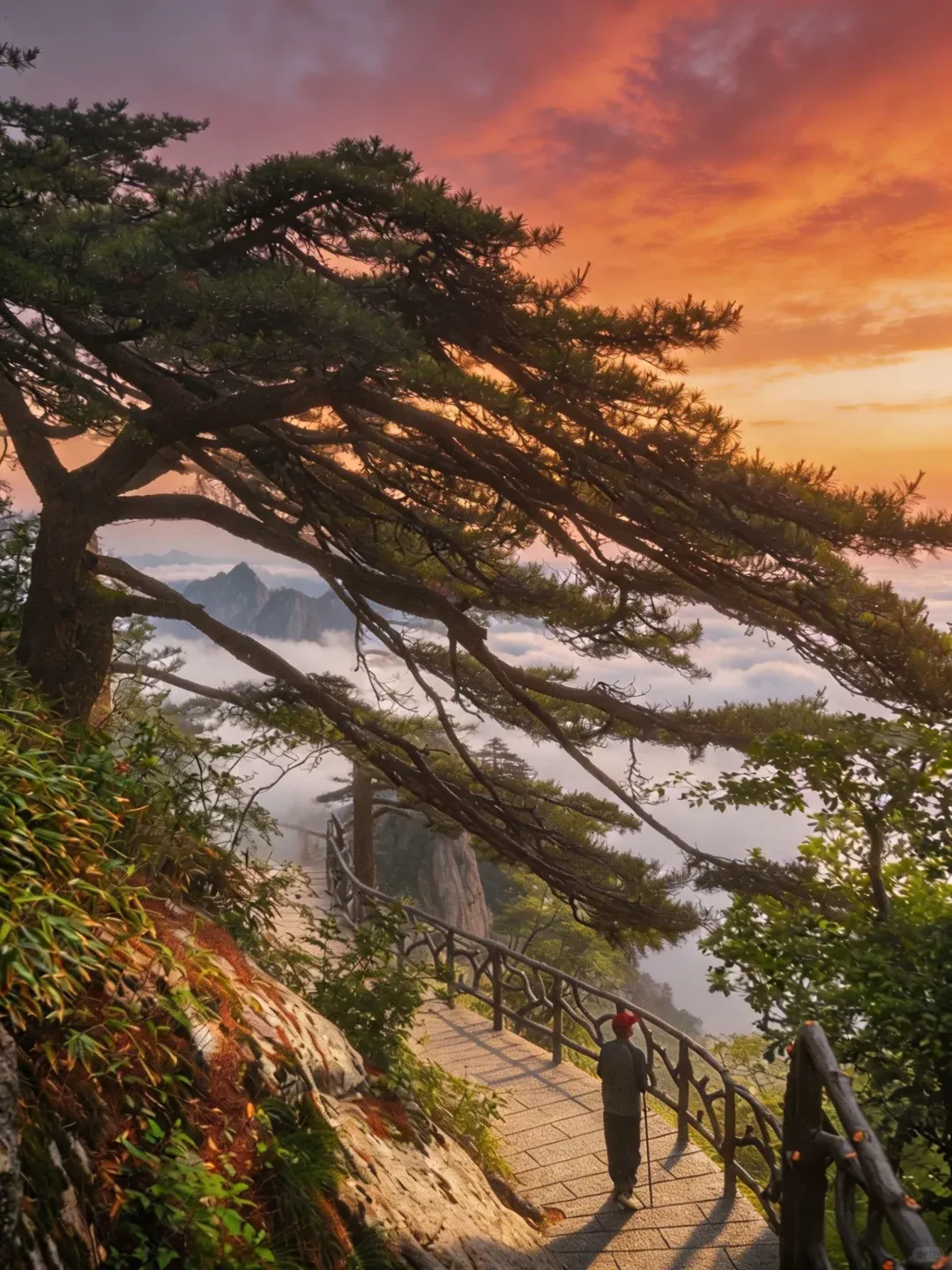
Mount Huangshan
Granite peaks, twisted pines and rolling cloud seas above Anhui's most iconic range, a UNESCO site since 1990.
 Written and signed by Marcus Yang
What it actually is
Mount Huangshan, a UNESCO World Heritage site since 1990, rises across 1,200 square kilometers of Anhui Province with 88 peaks above 1,000 meters. Its five wonders — ancient pines, fantastical rocks, rolling cloud seas, hot springs and winter snow — have inspired Chinese landscape painters for centuries. Three main summits exceed 1,800 meters.
Editor's take
Worth it for any traveler who likes mountains, but only if you can spare 2 days and go in autumn. The single-day sprint from the South Gate is exhausting and the summit is often in cloud by the time you arrive. Pick a clear-weather weekday, stay one night on top, and you'll understand why Xu Xiake said no other mountain is worth seeing after this one.
Essentials
Good to know
Trending now
Five Wonders of Huangshan
The mountain is famous for its 'Five Wonders' (Wu Jue): ancient pines (Qisong) that grow horizontally out of cliff cracks, fantastical rock formations (Guai Shi), the rolling Sea of Clouds (Yun Hai), natural hot springs (Wen Quan), and snow scenes in winter (Dong Xue). These five elements combine in nearly every classic view: one ancient pine against one granite pillar above a layer of cloud.
UNESCO Heritage since 1990
Mount Huangshan was inscribed as a UNESCO World Heritage site in 1990 for both its natural landscape and cultural significance. The mountain inspired the Huangshan School (Huangshan Huapai) of landscape painting that flourished during the Ming Dynasty (1368-1644 AD), when artists like Mei Qing rejected the southern Chinese focus on rivers and made granite peaks the new center of the genre. Over 300 cliff-face stone inscriptions from the Ming and Qing dynasties are still visible along the main trails.
Three main summits above 1,800 meters
Three summits dominate the park: Lotus Peak (Lian Hua Feng, 1,864 m), Bright Summit (Guang Ming Ding, 1,860 m), and Celestial Capital Peak (Tian Du Feng, 1,829 m). Bright Summit is the most accessible and offers the park's classic 360-degree sunrise view. Celestial Capital, closed for restoration every five years, is the steepest and most dramatic. Lotus Peak is the highest point and rotates between open and closed seasons.