
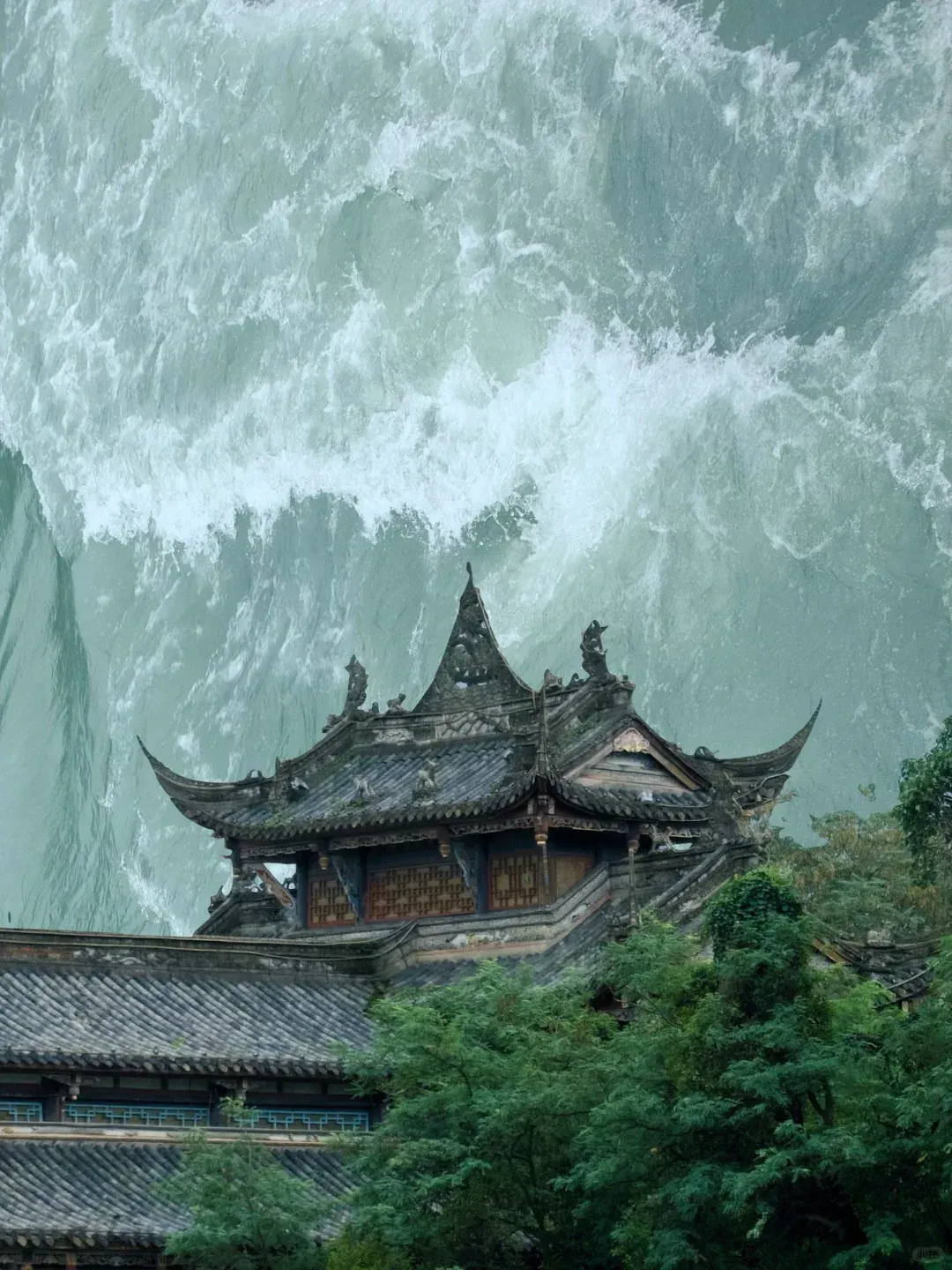
Dujiangyan Irrigation System
A 2,280-year-old gravity diversion on the Minjiang — world's oldest surviving no-dam irrigation, now UNESCO-listed.
 Written and signed by Lena Zhou
What it actually is
Built in 256 BC on the Minjiang River by Qin Governor Li Bing, this is the world's oldest no-dam diversion system — a 2,280-year-old working engineering site that still irrigates the Chengdu Plain, now paired with blue-lit Nan Bridge at night.
Editor's take
Worth it for anyone doing a Chengdu trip with half a day to spare, especially if you can spare 40 yuan for the group guide and go in spring or autumn. Skip if you only have a Chengdu weekend in July-August or hate tour groups — Qingcheng Mountain next door has fewer people but is a different experience (Taoist mountain, not water engineering).
Essentials
Good to know
Trending now
Yuzui Fish Mouth — the river splitter
Yuzui (Yu Zui, Fish Mouth) is a low triangular dike jutting into the Minjiang, splitting it into inner and outer channels without a dam. Built in 256 BC, it has balanced flood control and irrigation for over two millennia simply by exploiting the river's own bend. Best viewed from the Qin Yan Lou platform across the gorge — skip that platform on holidays, it gets shoulder-to-shoulder; the riverside walk below gives almost the same angle.
Baopingkou — the bottle-neck channel
Baopingkou (Bao Ping Kou, Bottle-Neck Channel) is a hand-cut 20m-wide gorge through Mount Yulei, carved by Li Bing's crews using fire-and-cool water cracking. It throttles floodwater into Chengdu while inner-channel flow stays steady year-round. Look down on it from the Erwang Temple (Er Wang Miao, Li Bing Memorial Hall) balcony — that one balcony angle is worth the climb.
Nan Bridge Blue Tears at night
Walk south across Minjiang after 8 PM and Nan Bridge (Nan Qiao, a 300m covered wooden bridge) glows blue from LEDs installed on its railings — locals call it lan yan lei (Blue Tears). Free, no ticket, no crowd if you go after 8:30 PM. Skip on rainy nights, the lights dim. Pair it with a stroll through Guanxian Old Town (Guan Xian Gu Zhen, a Ming-Qing old town quarter) for snacks on the way back.