
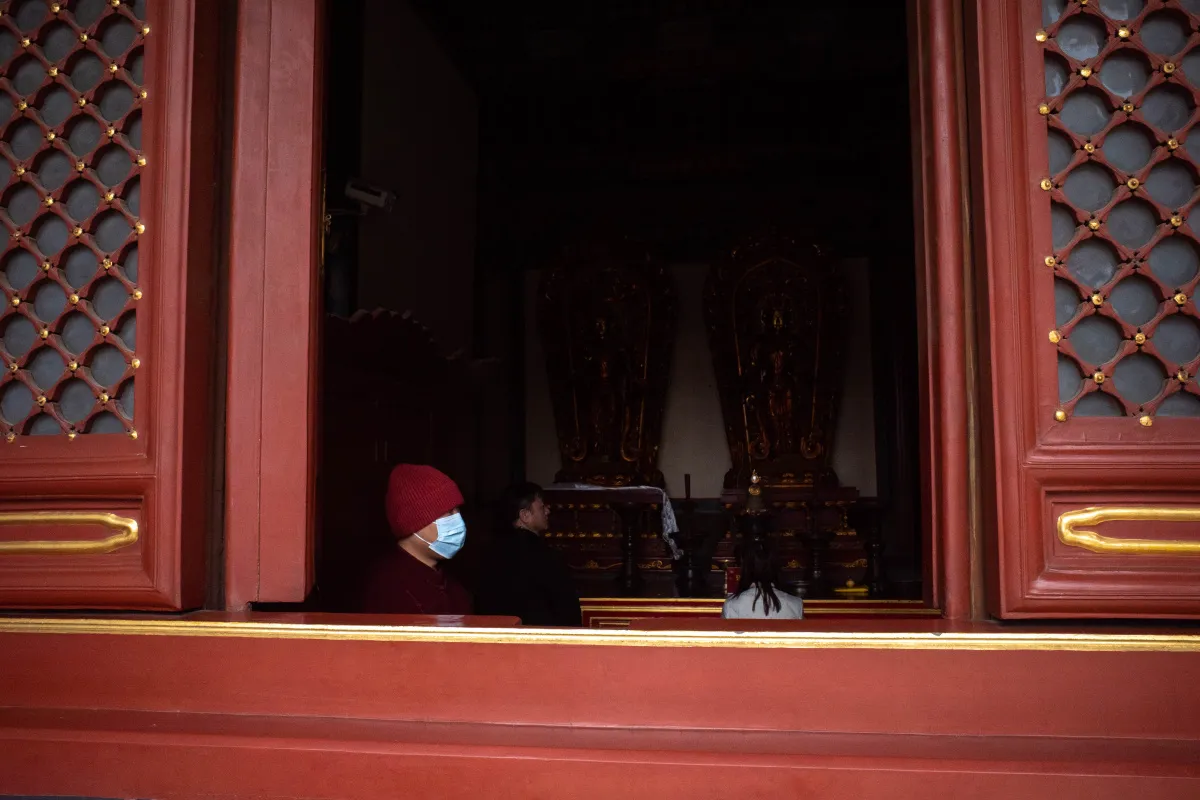
Yonghe Lama Temple
Beijing's largest Tibetan Buddhist temple, an emperor's birthplace with free incense and an 18-metre wooden Buddha.
 Written and signed by Xiangqun Li
What it actually is
Beijing's largest Tibetan Buddhist temple, built in 1694 as a prince's residence and converted in 1744. Five halls on one axis, free incense at the gate, and an 18-metre sandalwood Buddha at the rear, five minutes from its own metro station.
Editor's take
Worth it, and cheap enough that it barely needs justifying at CNY 25 for two hours. Go if you want to see an emperor's birthplace that is still a working Tibetan Buddhist temple rather than a restored shell, and go at 07:30 on a weekday, not at 11:00 on a Saturday. I would read up on which hall does what before you arrive, because on-site English is close to nonexistent. Skip it if you only care about photographing interiors, if you need quiet to enjoy a religious site, or if you are travelling in high summer with no tolerance for standing in open sun. Pair it with Guozijian Street and Wudaoying Hutong and you have a solid half day on foot.
Essentials
Good to know
Trending now
Flying Eaves and Golden Ridge Beasts
The roofs here carry imperial yellow glazed tile, a colour once reserved for emperors, because the complex began in 1694 as a prince's residence before becoming a temple in 1744. Stand at the foot of the main hall and look straight up: the upturned eaves, the row of small gilded ridge animals and the painted bracket sets are Qing Dynasty (1644-1912) carpentry.
Walking Into a Wall of Incense Smoke
Free incense is handed out just inside the gate, so you need not bring or buy any. Visitors light three sticks per hall and the courtyards fill with drifting smoke that catches the light between the roofs. Returning visitors describe the effect as unexpectedly calming even on a crowded morning, and it is the detail people remember most.
The Eighteen-Metre Standing Buddha
The rear pavilion holds a Maitreya Buddha carved from a single white sandalwood trunk, roughly 18 metres tall above floor level with a further eight metres set below. It fills the hall so completely that you must step back to the doorway to see the head. Photography is barred inside the halls, so this one is for looking, not shooting.
Prayer Beads From the Temple Counters
Three fawu liutong chu (counters selling blessed religious goods) sit inside the grounds. The one just past the ticket gate is free to enter but does not reach the blessing room; the counters beside Yongyou Hall and Falun Hall carry more styles and shorter queues. Incense-ash glaze and ceramic bracelets sell out fastest, so come early or on a weekday.
A One-Way Route Through Five Halls
The layout runs on a single north-south axis, so you can walk it without doubling back: gate, main hall, hall of everlasting protection, the Tibetan-style teaching hall, then the rear pavilion. Visitors who follow the axis in order finish in about two hours; those who wander tend to loop the site twice to reach the back exit.
Red Walls and Old Pines at Opening
Arriving at 07:30 buys roughly an hour before tour groups reach the second courtyard. The long red boundary wall and the ancient pines along the axis make the most photographed angle on site (best at 07:30-09:00 in Apr-Oct, when low sun rakes along the wall and the incense haze is still thin). Turn your phone flash off inside every hall.
Prayer Beads From the Temple Counters
Three blessed religious goods counters sit inside the grounds. The one just past the ticket gate is free to enter but does not reach the blessing room; the counters beside Yongyou Hall and Falun Hall carry more styles and shorter queues. Incense-ash glaze and ceramic bracelets sell out fastest, so come early or on a weekday.