
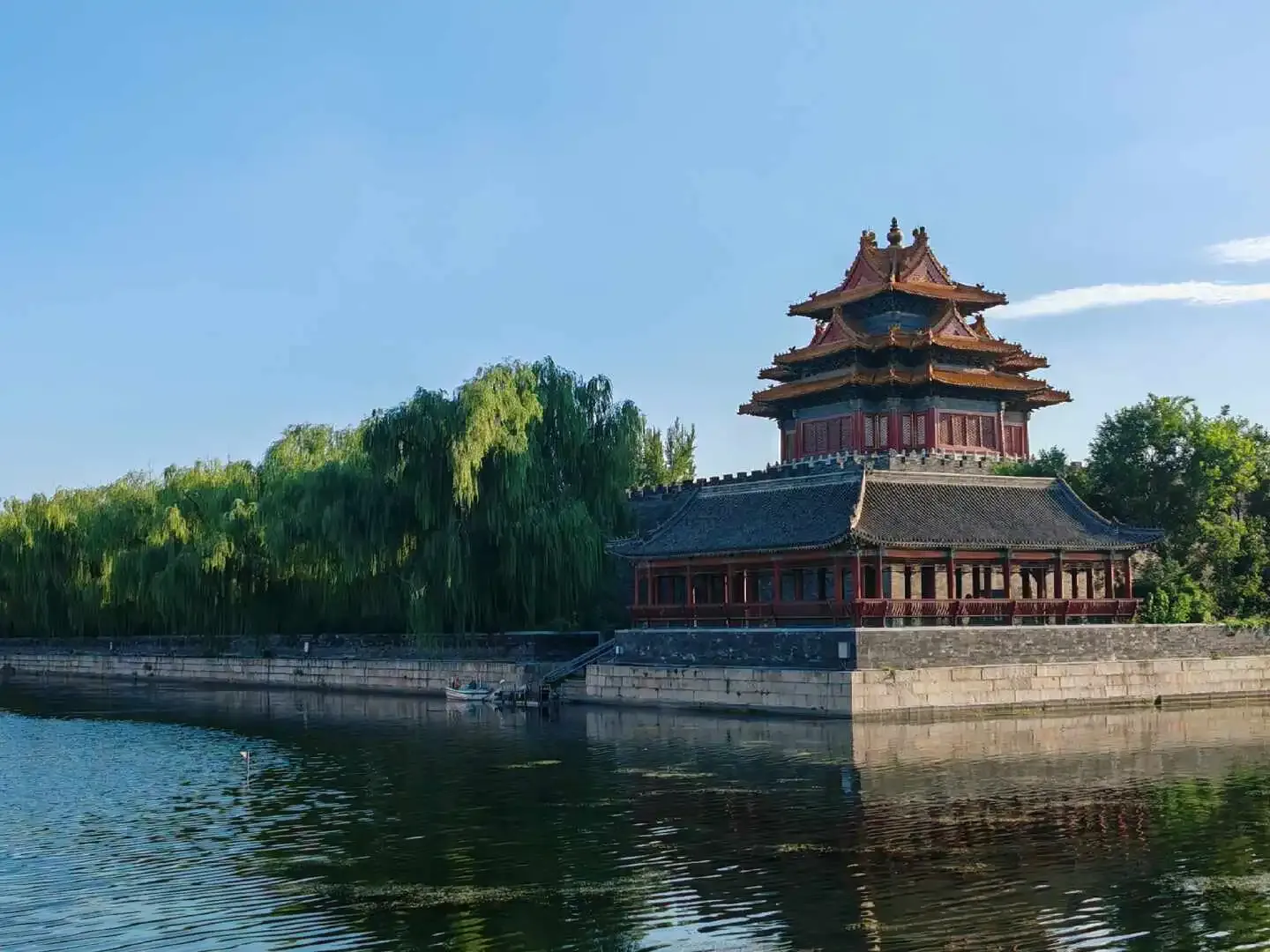
Jingshan Park
A Yuan Dynasty imperial garden on a 94 m man-made hill, Jingshan is the one place in Beijing where the entire Forbidden City unfolds beneath you in a single rooftop panorama.
What it actually is
Jingshan is a Ming-Qing imperial garden built on an artificial 94.2 m hill that first took shape in the Yuan Dynasty (1271-1368) on Beijing's central axis, directly north of the Forbidden City. From the summit pavilion Wanchun Ting the Forbidden City rooftops stretch out in one sweeping frame; on clear evenings the setting sun turns the glazed tiles into a sea of molten gold.
Editor's take
Worth a stop for anyone who has never seen the Forbidden City from above, and worth a repeat visit if you want to see Beijing's central axis without the tree cover. Skip if you have mobility issues or arrive at sunset on a weekend.
Essentials
Good to know
Trending now
Wanchun Ting Forbidden City View
Wanchun Ting sits 94.2 m above sea level, the highest pavilion on Beijing's central axis. From its south balcony the entire Forbidden City stretches out as one continuous roof sea; from the west side the Beihai Park white pagoda lines up neatly. Local travelers all agree that the 30 minutes before sunset produce the cleanest light on the glazed tiles.
Walk the Beijing Central Axis
Jingshan Park is the northern anchor of Beijing's 7.8 km central axis (a UNESCO World Heritage inscription since 2024, a north-south ceremonial line running through the heart of the city). Standing at Wanchun Ting you see this axis run straight south over the Forbidden City rooftops and north across the Drum Tower to the Olympic Tower on the horizon. The view is essentially a 700-year-old design statement, and it is free with admission.
Ming-Qing Imperial Garden Layout
The hill is an artificial mound raised in 1420 during the Ming Dynasty (1368-1644) using earth excavated from the palace moats and lakes. Five pavilions mark the cardinal directions (Zhou Shang, Guan Miao, Wanchun, Ji Fang, Fu Lan) and were rebuilt in their current form during the Qianlong reign (1735-1796). The hill was sealed as a private imperial garden until 1928, when it opened to the public.
A Hill Built from the Palace Moat
Jingshan is an artificial mound raised in 1420 during the Ming Dynasty using earth excavated from the palace moats and lakes. Five pavilions mark the summit and cardinal slopes (Zhou Shang, Guan Miao, Wanchun, Ji Fang, Fu Lan), rebuilt in their current form under the Qianlong emperor (1735-1796). Closed as a private imperial garden until 1928, the hill only opened to the public in the early Republican era.