
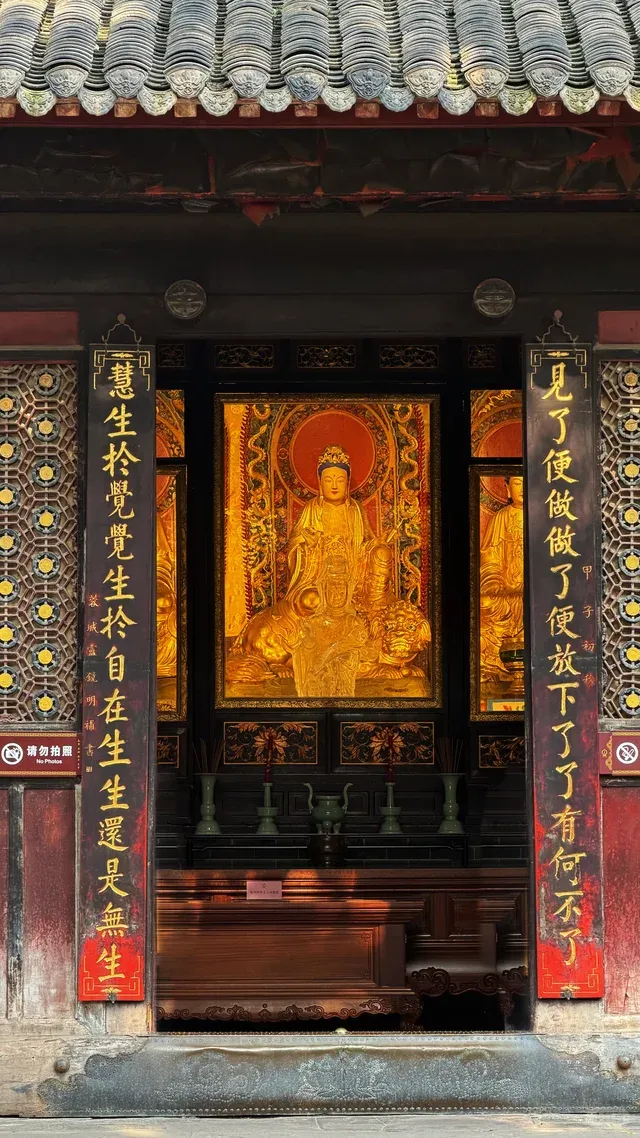
Wenshu Monastery
A 1,400-year-old Buddhist monastery hiding in downtown Chengdu, with red walls, ancient ginkgo trees, and quiet teahouses.
 Written and signed by Lena Zhou
What it actually is
Wenshu Monastery (Wenshuyuan, the Hall of Manjushri) is the best-preserved Buddhist temple in downtown Chengdu. Founded in the Sui Dynasty (605-617 AD) and rebuilt in the Qing Dynasty (1644-1912), it occupies over 200,000 sqm in Qingyang District. Visitors walk a central axis of six halls past ginkgo trees, then settle into a teahouse for Sichuan tea.
Editor's take
Worth a morning, especially if you pair it with the Aidao Hall nunnery next door. Best for travelers who want a calm, central, free activity in Chengdu. Skip if you dislike crowds or are looking for a high-impact scenic landmark — this is more about quiet than spectacle.
Essentials
Good to know
Trending now
A 1,400-Year-Old Temple in the Heart of the City
Wenshu Monastery was first built during the Sui Dynasty (581-618 AD, the dynasty that reunified China after the turbulent Southern and Northern Dynasties period). The current layout dates to a Qing Dynasty (1644-1912, China's last imperial dynasty) reconstruction in 1697. Despite being only a short walk from Tianfu Square, the inner courtyards stay remarkably calm.
Six Halls Along a Strict Central Axis
From the main gate (shanmen), the central axis runs through Tianwang Hall, Sansishi Hall, the Mahavira Hall (Daxiong Baodian, the main Buddha hall), the Scripture Hall (Shuofa Tang, where Buddhist teachings are explained), and the Sutra Library. The whole complex is a textbook example of Chuanxi (the western Sichuan) plain traditional architecture, with upturned eaves (feiyan) and inward-facing timber halls.
Ancient Ginkgo Trees and Autumn Drama
Two 100-year-old ginkgo trees flank the Drum Tower, and a grove sits next to Wenshu Pavilion. In mid-to-late November the leaves turn gold and contrast against the temple's red walls. The composition draws visitors who would otherwise skip the temple.