
Dazu Rock Carvings
A thousand years of Buddhist, Taoist and Confucian figures carved into Chongqing's cliffs. Chongqing's only UNESCO World Heritage site.
 Written and signed by Lena Zhou
What it actually is
China's last great cave-temple complex, Dazu Rock Carvings cluster 50,000+ Buddhist, Taoist and Confucian figures carved into cliffs at Baodingshan and four other mountains near Chongqing. UNESCO-listed since 1999, the carvings blend folk storytelling with refined Song-dynasty sculpture, making them feel startlingly alive.
Editor's take
Worth the half-day detour from Chongqing for anyone who already finds Dunhuang or Longmen interesting; skip if you are not willing to hire a guide, because the iconography is dense and the English context is thin. Best for travelers with one spare day who want a quieter cave-temple experience than the standard China circuit.
Essentials
Good to know
Trending now
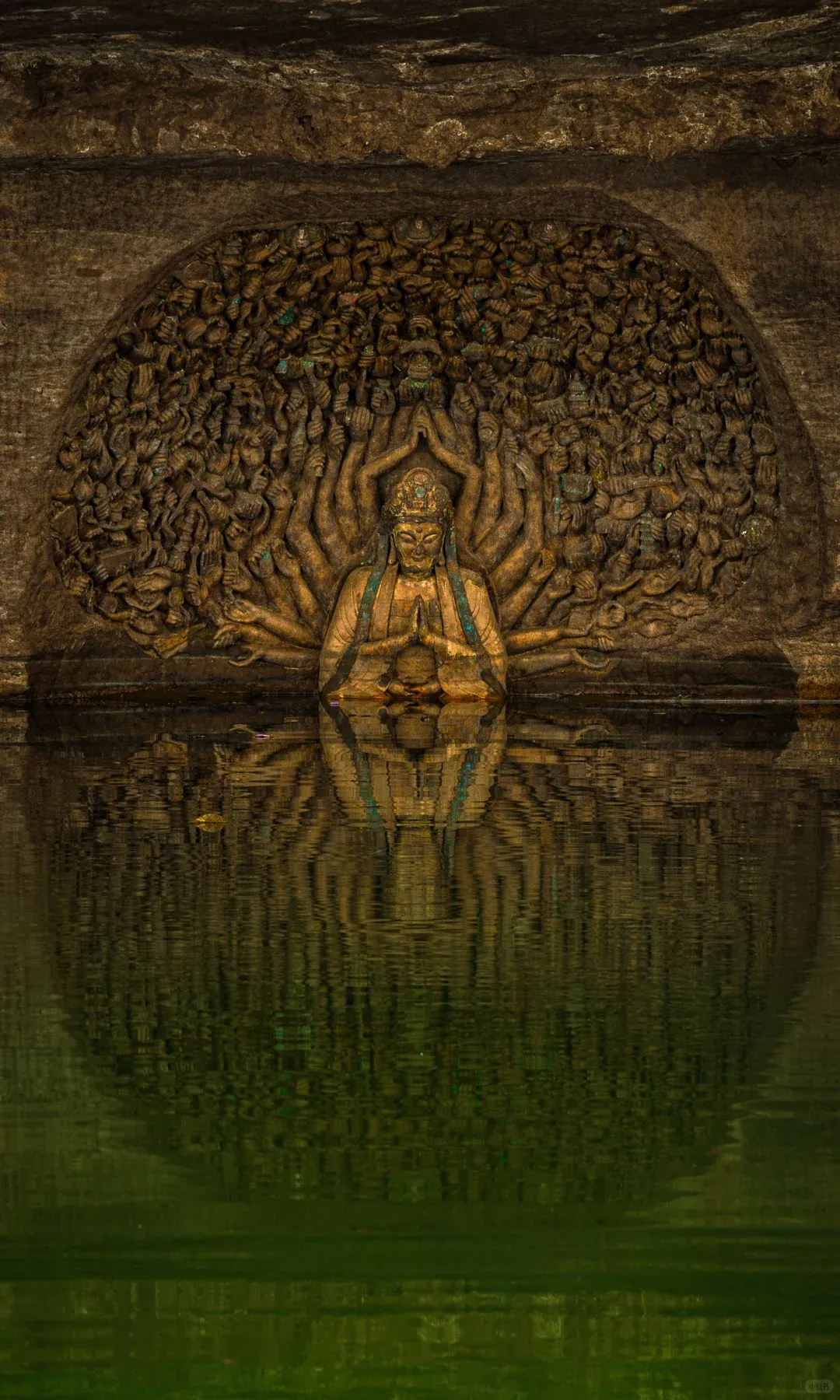
Baodingshan Thousand-Armed Guanyin
The Qian Shou Guanyin (Thousand-Armed Guanyin, a Bodhisattva of Compassion with a thousand helping hands) is the most photographed figure here, carved in the Southern Song dynasty (1127-1279 AD) and still shimmering with traces of mineral pigment. Each of the nearly-thousand hands holds a different eye, and when the late-afternoon sun rakes across the cliff the relief seems to breathe.
The Sleeping Buddha of Baodingshan
Baodingshan's centerpiece is a colossal Reclining Sakyamuni (the historical Buddha entering final nirvana) carved across an entire cliff, roughly 31 meters long, half-body only with feet disappearing into the rock. It is the largest stone half-reclining Buddha in the world, and locals call it the half-body Buddha because the lower half symbolically merges with the cliff.
A Three-Teaching Cliff
Unlike the pure-Buddhist sites at Yungang (Northern Wei dynasty caves in Shanxi) or Longmen (Tang dynasty (618-907 AD) grottoes near Luoyang), Dazu openly blends Buddhist, Taoist and Confucian (China's three classical teachings) figures side by side. A Taoist sage stands next to a Confucian scholar; a Buddhist arhat (an enlightened saint) smiles at both.