
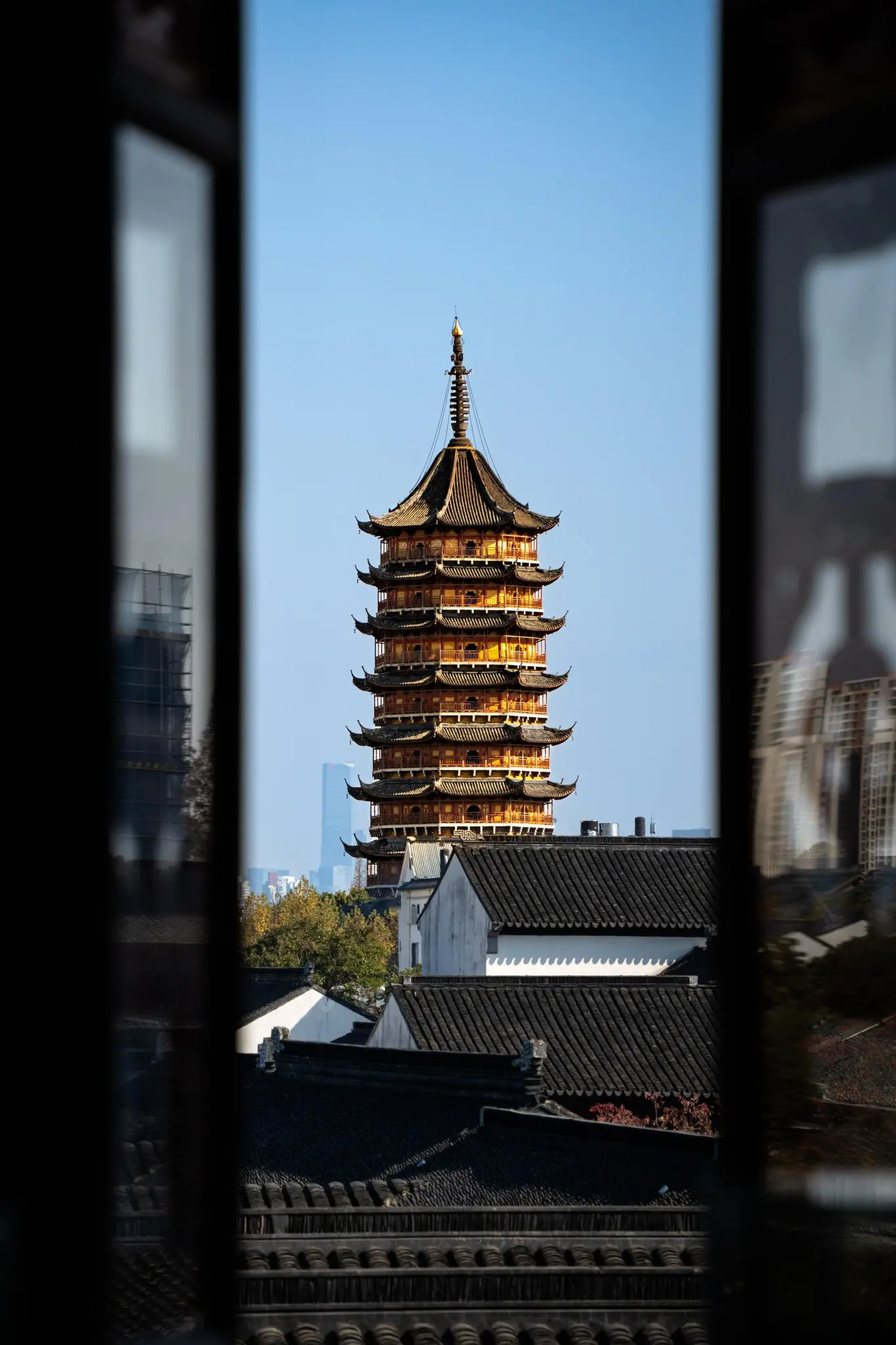
Dinghui Temple Alley Walk
A slow alley walk through Song-dynasty pagodas, ancient ginkgo courtyards, and a canal-side market in old Suzhou.
 Written and signed by Marcus Yang
What it actually is
A 2-3 hour alley walk in Suzhou's old Gusu district, threading from Dinghui Temple and its thousand-year ginkgo courtyard, through the free Wu Zuoren Art Museum with its koi-pond reflection of the Twin Pagodas, past the Song-dynasty Luohan Yuan pagodas, along Babao Street's spring rose walls, across the ancient Shouxing Bridge, and ending at the lively Shuangta Market.
Editor's take
This is the walk I'd send a friend who wants the 'real Suzhou' without the Shantang Street lantern crush. Worth it for the pagoda reflection alone. Best for photographers and slow-walk travelers who like history and food in one loop. Skip it if you're traveling in mid-July or if anyone in your group struggles on uneven ground.
Essentials
Good to know
Dinghui Alley Twin Pagodas Loop
A compact 2 km loop that strings together Dinghui Temple, Wu Zuoren Art Museum, the Twin Pagodas, Babao Street roses, Shouxing Bridge, and Shuangta Market. Most stops are free; allow 2-3 hours including food. Recommended start: 09:00.
- 1
Dinghui Temple· 30 min
Free entry. Two ancient ginkgo trees, brilliant gold in late November. Best light 9-11 AM.
- 2
Wu Zuoren Art Museum· 30 min
Free entry, closed Mondays. The rear courtyard koi pond mirrors both pagodas - the route's signature shot.
Walk ~150 m, ~2 min to the next stop.
- 3
Luohan Yuan Twin Pagodas· 20 min
CNY 8 entrance. Song-dynasty 1232 AD brick pagodas, the only surviving twin pair of that era in China.
Walk ~250 m, ~3 min to Babao Street.
- 4
Babao Street Roses· 20 min
Late March to late April only. Rambling roses spill over the garden walls at No. 10 and the No. 12 corner.
Walk ~300 m, ~4 min to Shouxing Bridge.
- 5
Shouxing Bridge & Canal Path· 25 min
One of Suzhou's oldest stone-arch bridges. Walk the canal-side path back toward the Twin Pagodas - the quietest stretch of the route.
Walk ~400 m, ~5 min to Shuangta Market.
- 6
Shuangta Market· 45 min
Working neighborhood market and snack street. Try Zhu Xinnian's red-broth noodles, Wang's Lin Ji shaobing, braised mutton from Xingfen. Closes around 19:00.
Trending now
Luohan Yuan Twin Pagodas (Song Dynasty 960-1279)
CNY 8 entrance. Built in 1232 AD during the Southern Song dynasty (960-1279), these twin seven-story brick pagodas are the only surviving pair of their era in China - 33 meters tall, leaning slightly after eight centuries. Locals call them the Brother Pagodas; you can photograph them from outside without paying, then walk on.
Wu Zuoren Art Museum Twin-Pagoda Reflection
Free entry, closed Mondays. The rear courtyard's koi pond catches both Song-dynasty (960-1279 AD) pagodas in a glassy mirror frame - the route's most photographed angle, best between 10 AM and noon when the sun lifts above the rooftops. The museum honors Wu Zuoren (1908-1997), founder of the influential Jiangsu painting school and former president of the Central Academy of Fine Arts.
Shuangta Market Su-Style Snacks
The walk ends at a working neighborhood market that doubles as a snack street. Try the red-broth noodles (hongshao mian, braised pork over hand-pulled wheat noodles) at Zhu Xinnian - a neighborhood staple since 1987 - or grab a freshly baked flatbread (shaobing, sesame-crusted oven-baked bread) from Wang's Lin Ji bakery. The red-broth tradition reflects Suzhou's preference for soy-and-sugar braised dishes, born of the city's long history as a soy sauce producing center along the Grand Canal.