
Emperor Qinshihuang's Mausoleum Museum
China's first emperor's underground army: eight thousand clay soldiers guarding him for over two millennia.
 Written and signed by Azalea
What it actually is
The mausoleum complex of China's first emperor (Qin Shi Huang, 259-210 BC) east of Xi'an, built to mirror his capital in the afterlife. Pit One holds over six thousand life-sized infantry; Pit Two adds cavalry and chariots; Pit Three is the command post. The same ticket also covers Lishan Garden across the road, home to the extraordinary Bronze Chariots Hall.
Editor's take
Worth a full half-day trip from Xi'an, even with the crowds. Anyone interested in ancient history, sculpture, or imperial China should not skip it. Skip it if you cannot handle standing in queues or if you only have two hours in Xi'an (in which case the Xi'an City Wall or the Muslim Quarter will reward you better).
Essentials
Good to know
Trending now
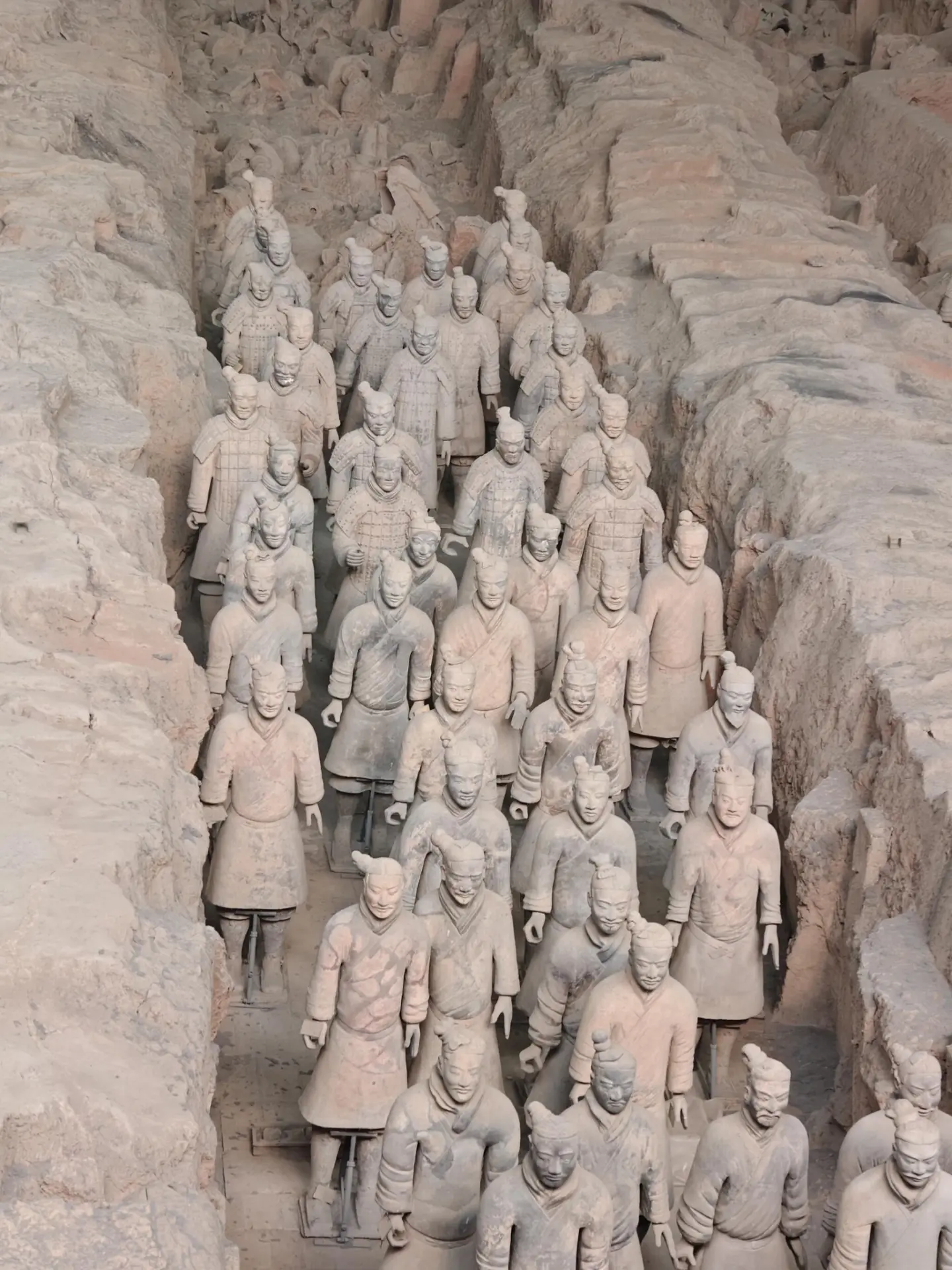
Pit One's standing infantry phalanx
Pit One (Yi Hao Jing, Excavation Pit 1) is the showstopper: eleven parallel trenches holding over six thousand life-sized infantry in forward-march formation. Each figure has unique facial features and rank insignia, hand-finished in the Qin Dynasty (221-206 BC, China's first unified empire). Get to the front-left railing or the elevated right-side viewing platform for the unblocked full-phalanx view.
Bronze Chariots in Lishan Garden
Across the road, the Bronze Chariots Hall (Tong Che Ma Bo Wu Guan) holds two original half-scale bronze chariots unearthed in 1980 from the Qin emperor's tomb mound. Their silver-and-gold wire parasols and yoke harnesses are the most complex bronze castings surviving from pre-imperial China. The same ticket covers both sites, plan the loop.
Pit Three's painted command post
Pit Three (San Hao Jing, Excavation Pit 3) is the smallest but contains the only surviving painted terracotta figures: 68 officers and chariot commanders with original pigment traces on their robes. Pit Three was never burned, so its wall murals and column details are the best preserved. Stand at the southern corner for the angled-light view of the painted lines.
Bronze Chariots in Lishan Garden
Across the road, the Bronze Chariots Hall (Tong Che Ma Bo Wu Guan) holds two original half-scale bronze chariots unearthed in 1980 from the Qin emperor's tomb mound. Their silver-and-gold wire parasols and yoke harnesses are the most complex bronze castings surviving from early imperial China. The same ticket covers both sites, plan the loop.